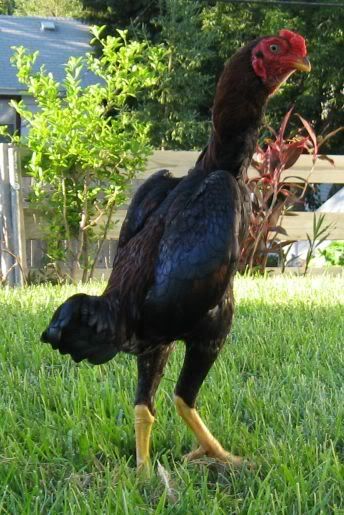
Ayam Cemani Cross.
If anyone has a rooster of this type , please contact us.
Qaib Hmong or
Hmoob Qaib Xiav Nqaij
Dark Skin Brood
Photographer: Yong Moua

A cockfight is a blood sport between two roosters (cocks), held in a ring called a cockpit. Cockfighting is now illegal throughout all states in the United States,INDIA, Brazil, Australia and in most of Europe.It is still legal in several U.S. territories.
Ayam Cemani Cross.
If anyone has a rooster of this type , please contact us.
Qaib Hmong or
Hmoob Qaib Xiav Nqaij
Dark Skin Brood
Photographer: Yong Moua


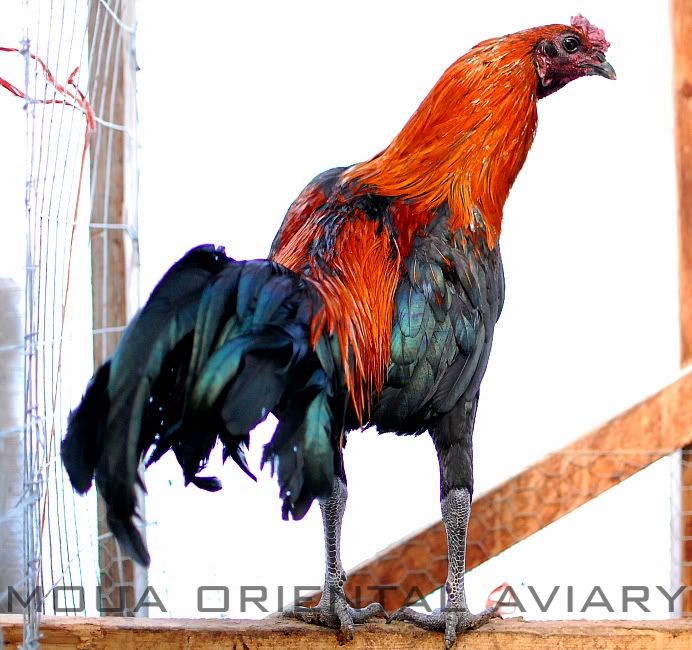

Qaib Hmong or
Hmoob Qaib Xiav Nqaij Qaib Hmong or
Hmoob Qaib Xiav Nqaij
Dark Skin Brood
Photographer: Yong Moua
Dark Skin Brood
Photographer: Yong Moua
Viet Nam, home of Gà Nòi
The origin of gà nòi is unknown. Its history cannot be traced due to the lack of documentation. The 30 years civil war ended in 1975 that killed millions and ruined the whole country further contributed to the lack of information.
Cockfighting in Viet Nam is an old tradition dating back at least 700 years. Gà Nòi is believed to be native of Viet Nam as there is no credible evidence of its origination from elsewhere. Gà nòi have been exported to neighboring countries such as Thailand, Indonesia, and Malaysia in recent decades. Vietnamese cockers living in the United States had also brought gà nòi to the States. Fowls bearing physical resemblance to ga noi can also be found in the Reunion Island.
For people who are interested in researching the origin of ga noi, a recent study conducted by a Japanese team on the origin of all chickens in the world can be found at www.accessexcellence.org. The new findings by the Japanese researchers suggest that domestication took place more than 8,000 years ago in what is now Thailand and Vietnam, the region in which the red jungle fowl is found today. You can click on this PROTOCHICKEN link to read more about the study.
Definition
According to "Đại Nam Quốc Âm Tự Vị" a linguistic research book in Vietnamese language, published by a scholar named Huỳnh Tịnh Của (Volume II, in 1896 - page 155), the word "Nòi" means:
Nòi = bloodline, breed. (Vietnamese writing uses diacritical mark)
Gà Nòi = A special type of chicken people breed for fighting purpose.
Rặt Nòi (entirely nòi) = A pure breed, no cross-breeding with the unknown type
Vương Hồng Sển, a respected author who told stories of cockfighting in 1915 in his book "Phong Lưu Cũ Mới", published in 1961, gave another definition of "Nòi" as:Race
An ancestral line
A distinguish ancestry
A recorded purity of breed of an individual or strain
The DICTIONNAIRE ANNAMITE-FRANCAIS prepared and edited by G�nibrel, J-F-M published in 1898 also gave similar definition as above.
The term gà nòi refers to two separate breeds of fighting fowls. They are gà đòn (short for gà nòi đòn) and gà cựa (short for gà nòi cựa).
Đòn = hitting, whipping, caning, thrashing.
Cựa = Spur
Article courtesy of www.ganoi.com
More information can be found on this wonderful, ancient breed at:
http://www.ganoi.com/ganoi.htmlPhotos below:
He is a five year old Gadon (2005) out of Vietnam imported stock. He is a true first generation Gadon and still breeding strong.
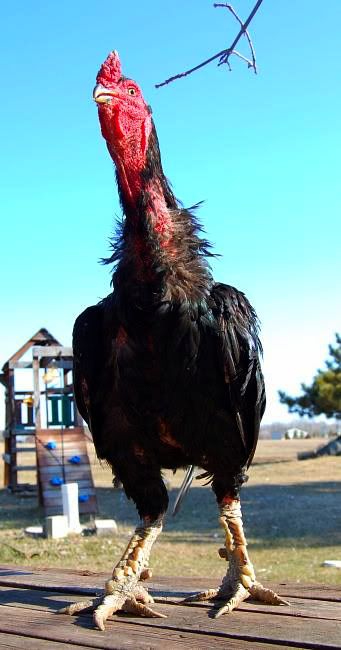
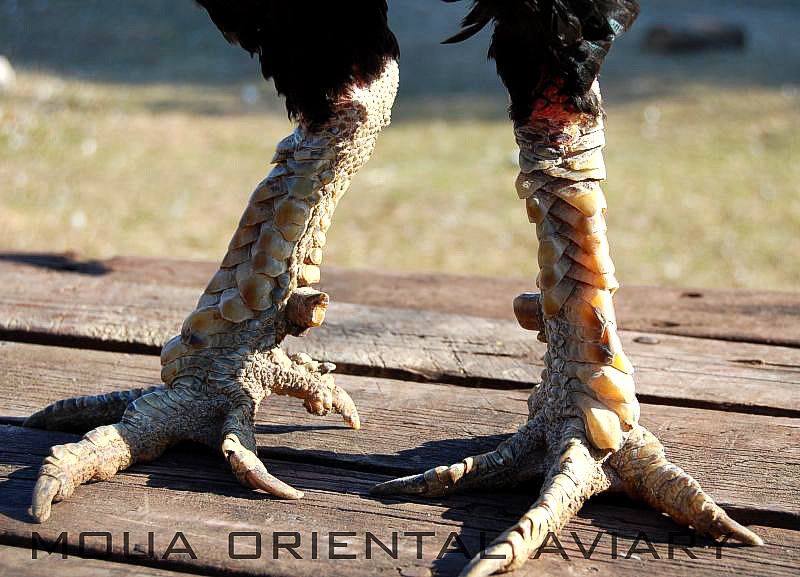
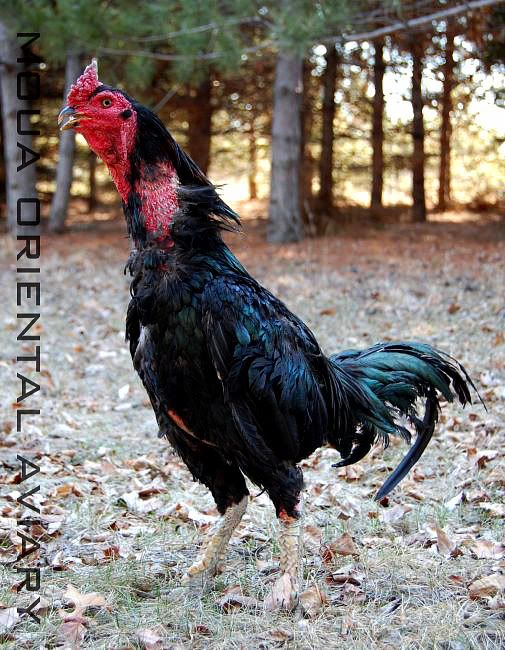
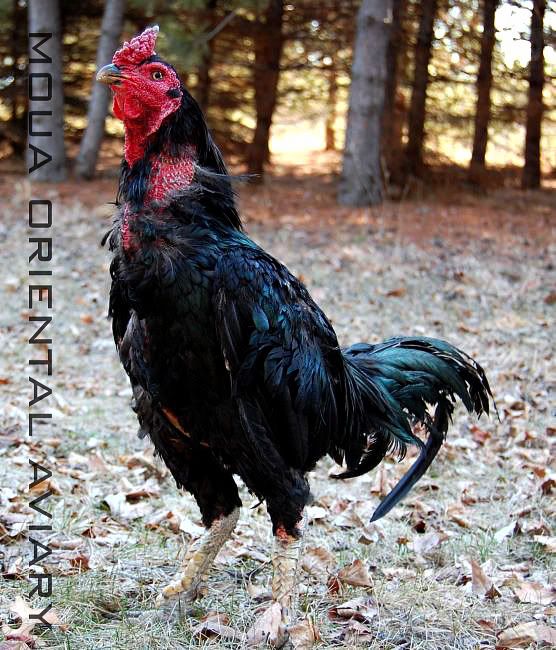
These are the 2009 offspring to the Gadon cock above. Their dam is a 2nd generation pure Gadon Hen. Majority of the stags have the same trait as their father: Large, dry, single ring shanks.
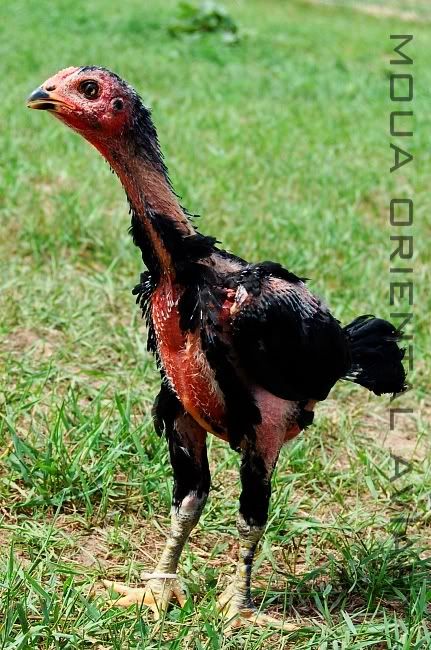
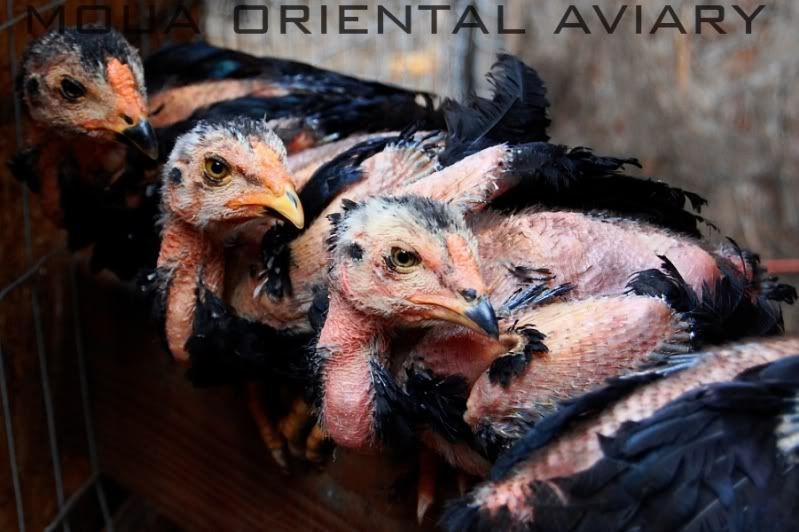


Shamo: Pure Japanese Line
The Shamo is a naked heel game bird from Japan.
The breed was originally brought into Japan from Thailand in the seventeenth century - the name referring to Siam, the old name for Thailand. In Japan it was developed into a distinctive fighting bird of courage and ferocity.
Its posture is very upright, with prominent shoulders, powerful bone structure, muscular build and sparse hard feather, which all together make it an impressive and striking bird.
The term "Shamo" covers all examples of the large fowl, but they can be further divided by weight into Chu Shamo (adult male weight above 3kg) and O Shamo (adult male weight 4kg and above).
The breed can be found throughout Japan and although occasionally shown they are kept there primarily as fighting birds, with character and attitude being the vital attributes. Cockfighting is legal in Japan, although betting on the outcome is not. Colour is of no importance in this breed, although the plumage colour most commonly seen is black/red (bbr) and variations; beak - yellow or horn; legs and feet - yellow (with blackish over-colour being normal in some dark coloured birds); face - red; and eyes silver or gold.
(introduction was provided courtesy of Shamolady)
Ko Shamo
Background information: The Japanese are masters in minimizing objects and living things (bonsai trees, chicken, fish) The geographical conditions in Japan gave birth to this extra ordinary skill. There is almost no space to build as Japan is for 75% a country with hills and mountains. To enable indoor keeping of gamefowl they have created the Ko Shamo, a small game breed still in possession of a game character. A trio of these birds are kept on a space of 4 square feet. Despite these conditions fertility is excellent same as their laying performance and hatch rate. Growing up the chicks goes without problems, however a too overcrowded surface leads to a bloody war in the sense of the word as they display their "killer" instinct in an early live stage. Ko Shamo are very popular in Japan and Europe due to their qualities. They have following features: strawberry or walnut comb, pearlish eyes, extremely short in feathers, wings carried from the body the wing joints pointing above the shoulders.The tail is known as "shrimp" tail (main sickle feathers curving down, side feathers pointing in horizontal direction). Also a very typical feature is the socalled open or split wing which in Japan is seen at the best birds. The whole body is divided in 3 equal parts (length) 1) head and neck, 2) body, 3) legs. Weight: male 2 Lbs (0.9 Kg), female 1.8 Lbs (0.8 Kg). Height: 9.8" (± 25 Cm). Another typical feature is that Ko Shamo walk on their front toes. Dispite the fact that Ko Shamo's succesfuly can be kept and bred under less fortunate conditions it is advised to give these birds sufficient space. Ko Shamo's are bred in a wide variety of colours. Its an ideal bird for the less fortunate (concerning living space) fancier of Asian gamefowl.
Source:
Shinichi Zenimoto (Japan)
Ikuo Watanabe (President of the Japan Small Shamo Club)
(www.geocities.com/Tokyo/Shrine/2425/koshamo.htm)
The Ko Shamo is a bantam game breed from Japan.
It is the most numerous of the small Shamo breeds, being popular in all areas of Japan, but it is not a bantam version of the large Shamo. They are strong muscular little birds with very sparse plumage. Their most important attributes should be character and attitude, strong head and beak, upright stance, prominent shoulders, very short hard feather, and tiny prawn� tail (which means a tail like a prawn�s tail, not like a prawn). The weight of an adult male is around 1kg.
Different types are considered to be correct in Japan, so there will always be variation within the breed, some lighter, some chunkier, some with wrinkly faces, some not so wrinkly - but they should all have the typical Ko Shamo attributes, especially the characteristic cheeky, cocky attitude. However, despite the game spirit, this is an ornamental pet and show breed, not designed for fighting.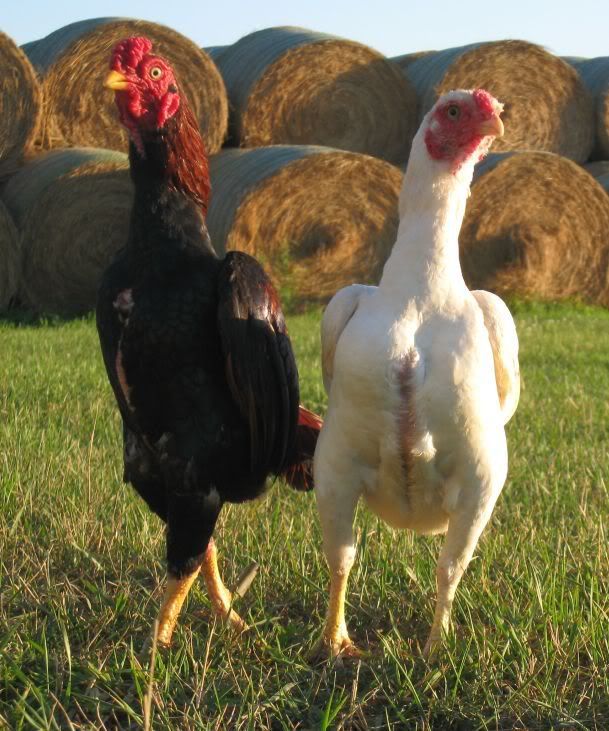 There are no fixed plumage colours but, as an ornamental breed, attractive colouration can add to the appeal of a good bird. Normal colouration is: beak yellow or horn; legs and feet yellow, with dusky markings also being acceptable in dark coloured birds; face- red; and eyes silver o
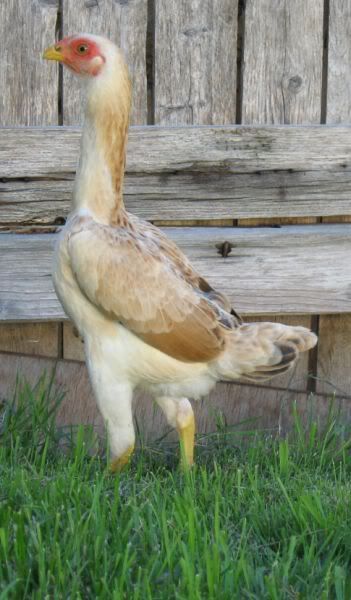
r goThis pullet is out of Micheal Stumme's strain as well. What a pullet she is! Thanks Suzann!
"They are BEAUTIES!!! Definitely the best I have seen in USA. Type-wise they are as good as any in the world. Excellent!" Julia Keelingld.